
Class 5 Comma with Nonessential Clause Worksheet

Class 5 Comma with Nonessential Clause Worksheet
Extra Information Made Easy: Comma with Nonessential Clauses for Class 5
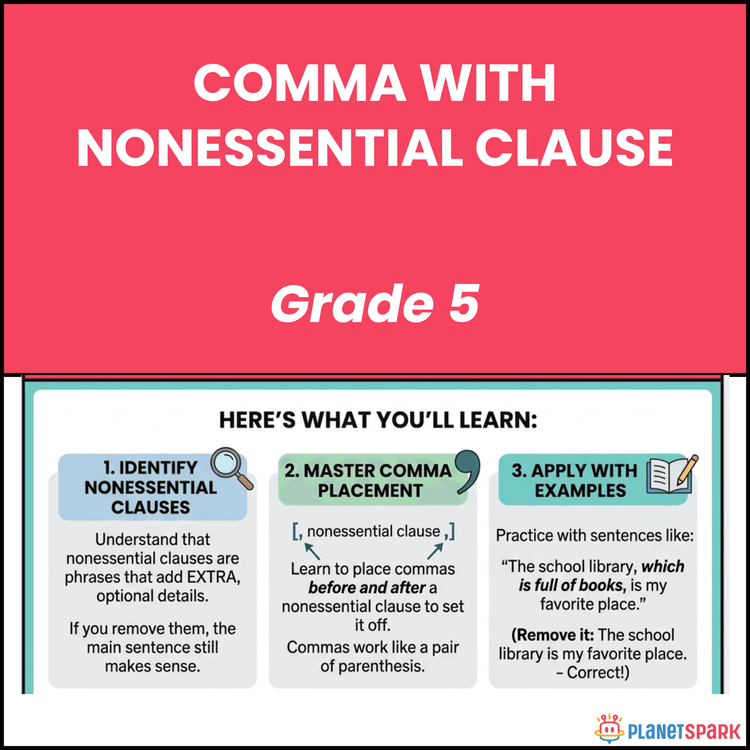
This Grade 5 grammar worksheet helps students understand how commas are used to separate nonessential clauses in a sentence. A nonessential clause adds extra information about a noun but is not necessary for the basic meaning of the sentence. Learning to punctuate these clauses correctly helps students write clearer, more polished sentences.
In this worksheet, learners explore the concept through multiple grammar-building exercises such as multiple choice questions, true or false identification, comma placement, sentence correction, and paragraph-based practice. These varied activities help students recognize when extra information should be separated by commas and when it should not.
Why Commas with Nonessential Clauses Matter in Grammar?
Understanding commas with nonessential clauses is important for Grade 5 learners because:
1. Nonessential clauses provide additional details about a person, place, or thing.
2. They are separated from the rest of the sentence using commas.
3. Removing the clause should not change the main meaning of the sentence.
4. Correct punctuation improves clarity in writing and reading comprehension.
What’s Inside This Worksheet?
This worksheet includes five grammar-focused activities that help students master commas with nonessential clauses:
Exercise 1 – Multiple Choice (Correct Comma Placement)
Students choose the sentence that correctly uses commas to set off a nonessential clause. This activity strengthens their understanding of how commas frame additional information within a sentence.
Exercise 2 – True or False
Learners read sentences and decide whether commas are used correctly with the nonessential clause. This encourages careful reading and punctuation awareness.
Exercise 3 – Fill in the Blanks with Commas
Students insert commas in the correct places to mark the beginning and end of a nonessential clause. This helps them practice punctuation directly within sentences.
Exercise 4 – Sentence Correction
Students replace an incorrect relative word (such as who, which, or that) with the correct one from a word box to make the sentence grammatically accurate.
Exercise 5 – Paragraph Practice
Students read a short paragraph and add commas in the correct places to mark nonessential clauses. This activity helps them apply the concept in real reading and writing situations.
Answer Key (For Parents & Educators)
Exercise 1 – Multiple Choice
1. b
2. b
3. c
4. b
5. a
6. b
7. a
8. c
9. a
10. b
Exercise 2 – True or False
1. True
2. True
3. False
4. False
5. False
6. False
7. False
8. True
9. True
10. True
Exercise 3 – Fill in the Blanks with Commas
1. Riya, who runs daily, won the race.
2. The teacher, who teaches English, smiled.
3. The bus, which arrives daily, was late.
4. Meera, who loves books, reads often.
5. The shop, which opened today, sells sweets.
6. The park, which is nearby, looks clean.
7. The dog, which chased cats, barked loudly.
8. The river, which runs here, flows fast.
9. The player, who trained hard, scored twice.
10. The guide, who helped us, spoke kindly.
Exercise 4 – Sentence Correction
1. The teacher who teaches English smiled.
2. The dog which chased cats barked loudly.
3. Riya who runs daily won the race.
4. The shop which opened today sells sweets.
5. The river which runs here flows fast.
6. The player who trained hard scored twice.
7. The guide who helped us spoke kindly.
8. The park which is nearby looks clean.
9. The bus which arrives daily was late.
10. Meera who loves books reads often.
Exercise 5 – Paragraph Comma Placement
Riya, who loves reading, visits the library every afternoon after school.
The park, which is near our school, looks beautiful during spring.
Help your child write clearer and more confident sentences by mastering punctuation and clause structure through guided communication practice.
Frequently Asked Questions
A nonessential clause adds extra information to a sentence and is separated by commas because the sentence still makes sense without it.
Commas show that the added phrase is not necessary for the sentence's meaning and help readers understand the sentence structure clearly.
If removing the clause does not change the core meaning of the sentence, it is likely a nonessential clause.